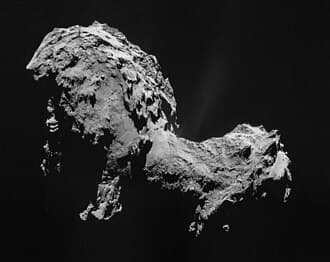
67P/Churyumov–Gerasimenko
百科词条From Wikipedia

67P/Churyumov–Gerasimenko

67P/Churyumov–Gerasimenko (abbreviated as 67P or 67P/C–G) is a Jupiter-family comet. It is originally from the Kuiper belt and has an orbital period of 6.45 years as of 2012, a rotation period of approximately 12.4 hours, and a maximum velocity of 135,000 km/h (38 km/s; 84,000 mph). Churyumov–Gerasimenko is approximately 4.3 by 4.1 km (2.7 by 2.5 mi) at its longest and widest dimensions. It was first observed on photographic plates in 1969 by Soviet astronomers Klim Ivanovych Churyumov and Svetlana Ivanovna Gerasimenko, after whom it is named. It most recently came to perihelion (closest approach to the Sun) on 2 November 2021, and will next come to perihelion on 9 April 2028. Churyumov–Gerasimenko was the destination of the European Space Agency's Rosetta mission, launched on 2 March 2004. Rosetta rendezvoused with Churyumov–Gerasimenko on 6 August 2014 and entered orbit on 10 September 2014. Rosetta's lander, Philae, landed on the comet's surface on 12 November 2014, becoming the first spacecraft to land on a comet nucleus. On 30 September 2016, the Rosetta spacecraft ended its mission by landing on the comet in its Ma'at region.

Categories

All Wikipedia articles written in American EnglishAll articles containing potentially dated statementsAll articles with unsourced statementsAnubisArticles containing potentially dated statements from July 2016Articles containing potentially dated statements from September 2014Articles with short descriptionArticles with unsourced statements from August 2015

Quick Facts

Aphelion
5.704 AU     (853.3 million km; 530.2 million mi)
Alternative names
1969 R1, 1969 IV, 1969h, 1975 P1, 1976 VII, 1975i, 1982 VIII, 1982f, 1989 VI, 1988i[1]
Discovered by
Klim Ivanovich ChuryumovSvetlana Ivanovna Gerasimenko
Discovery date
20 September 1969
Discovery site
Almaty, Kazakh SSR, Soviet UnionKyiv, Ukrainian SSR, Soviet Union