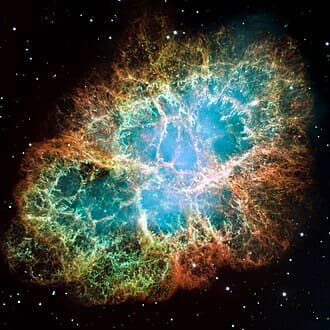
SN 1054
SN 1054, the Crab Supernova, is a supernova that was first observed on c. 10 July [O.S. c. 4 July] 1054, and remained visible until c. 12 April [O.S. c. 6 April] 1056.α The event was recorded in contemporary Chinese astronomy, and references to it are also found in a later (13th-century) Japanese document and in a document from the Islamic world. Furthermore, there are a number of proposed references from European sources recorded in the 15th century, as well as a pictograph associated with the Ancestral Puebloan culture found near the Peñasco Blanco site in New Mexico, United States. The pyramids at Cahokia in the midwestern United States may have been built in response to the supernova's appearance in the sky. The remnant of SN 1054, which consists of debris ejected during the explosion, is known as the Crab Nebula. It is located in the sky near the star Zeta Tauri (ζ Tauri). The core of the exploding star formed a pulsar, called the Crab Pulsar (or PSR B0531+21). The nebula and the pulsar that it contains are some of the most studied astronomical objects outside the Solar System. It is one of the few Galactic supernovae where the date of the explosion is well known. The two objects are the most luminous in their respective categories. For these reasons, and because of the important role it has repeatedly played in the modern era, SN 1054 is one of the best known supernovae in the history of astronomy.