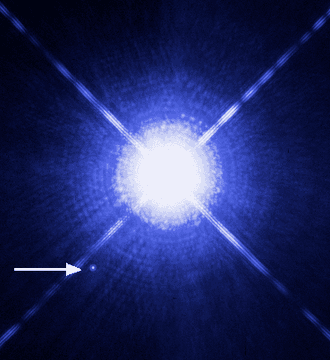
White dwarf
A white dwarf is a very dense type of star: in an Earth-sized volume, it packs a mass that is comparable to the Sun. A white dwarf radiates light from residual heat, not from nuclear fusion. Stars like the Sun, whose mass is not high enough to collapse into a neutron star or black hole, are expected to become white dwarf stars later in their evolution. The nearest known white dwarf is Sirius B, at 8.6 light years, the smaller component of the Sirius binary star. In 1910, Henry Norris Russell, Edward Charles Pickering and Williamina Fleming discovered that, despite being a dim star, 40 Eridani B was of spectral type A, or white. This would become known as the first white dwarf. The name white dwarf was coined by Willem Jacob Luyten in 1922. In 1931 Subrahmanyan Chandrasekhar developed a physical model of white dwarfs and he won the 1983 Nobel Prize in Physics for studies in the evolution of stars. These compact stars are composed mostly of a highly compressed form of matter. The composition of the white dwarf produced will depend on the initial mass of the star.