Neo-Assyrian Empire
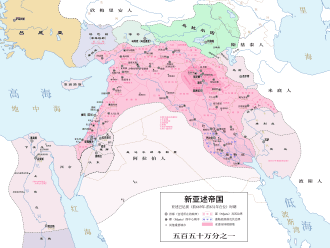
The Neo-Assyrian Empire was the fourth and penultimate stage of ancient Assyrian history. Beginning with the accession of Adad-nirari II in 911 BC, the Neo-Assyrian Empire grew to dominate the ancient Near East and parts of the South Caucasus, North Africa and the Eastern Mediterranean throughout much of the 9th to 7th centuries BC, becoming the largest empire in history up to that point. Because of its geopolitical dominance and ideology based in world domination, the Neo-Assyrian Empire has been described as the first world empire in history. It influenced other empires of the ancient world culturally, administratively, and militarily, including the Neo-Babylonians, the Achaemenids, and the Seleucids. At its height, the empire was the strongest military power in the world and ruled over all of Mesopotamia, the Levant and Egypt, as well as parts of Anatolia, Arabia and modern-day Iran and Armenia. The early Neo-Assyrian kings were chiefly concerned with restoring Assyrian control over much of northern Mesopotamia, eastern Anatolia and Levant, since significant portions of the preceding Middle Assyrian Empire (1365–1050 BC) had been lost during the late 11th century BC. Under Ashurnasirpal II (r. 883–859 BC), Assyria once more became the dominant power of the Near East, ruling the north undisputed. Ashurnasirpal's campaigns reached as far as the Mediterranean, and he oversaw the transfer of the imperial capital from the traditional city of Assur to the more centrally located Kalhu (later known as Calah in the Bible and Nimrud to the Medieval Arabs) The empire grew even more under Ashurnasirpal's successor Shalmaneser III (r. 859–824 BC), though it entered a period of stagnation after his death, referred to as the "age of the magnates". During this time, the chief wielders of political power were prominent generals and officials, and central control was unusually weak. This age came to an end with the rule of Tiglath-Pileser III (r. 745–727 BC), who re-asserted Assyrian royal power and more than doubled the size of the empire through wide-ranging conquests. His most notable conquests were Babylonia in the south and large parts of the Levant.